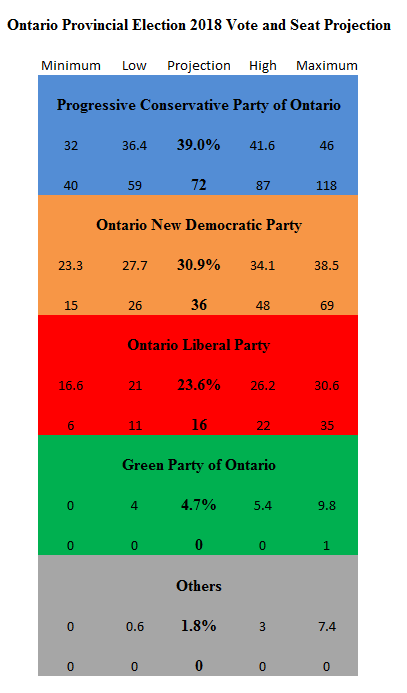
On June 7th, the Ontario PCs won a strong majority government. I was out of town then, so my polls projection only appears now. I have included a brief analysis of what the polls said versus what actually happened at the ballots.
This projection slows a very slim PC majority.
This is a graph of all the polls. We can clearly see how the NDP rose then peaked and then fell, mirroring the fall and then the small bump in polls for the Liberals. The PCs late campaign surge is also apparent.
Here we see the predictions by the polls versus the election results. The polls underestimated the PC's vote and overestimated the NDP. The small lead the PCs appeared to have over the NDP turned out to be a very comfortable one (seven points). My model caught the correct seat count for the Progressive Conservatives and New Democrats between the high/low and min/max ranges. Not the best result for the model, but decent compared to the pollsters' inaccuracies.
Just a final thought, this election result is very similar to the federal Conservatives' win back in 2011. The final result back then was 40-31-19 for CPC-LPC-NDP and the results for Ontairo 2018 were 41-34-20 for OPC-OLP-ONDP. The percentages would be even closer if there was no Bloc Quebecois on the federal level who netted 6% which would be distributed to the other parties, especially the Liberals and NDP. Pretty cool stuff.
For the election junkies out there, the next one will be Quebec 2018 this fall, so stay tuned!
Showing posts with label Other Elections. Show all posts
Monday, June 18, 2018
Friday, June 01, 2018
Ontario Election 2018: June 1st Projection
It is a razor close race now between the PCs and the NDPs with Doug Ford's party maintaining a small edge, enough to win them a majority government.
The New Democrats have definitely caught up to the Progressive Conservatives, thanks to the Liberals' fall, but it seems that this surge may not be enough to stop the PCs from forming government on June 7. But the only thing that we know for certain right now is that Wynne's Liberals will no longer be the party in power.
Monday, May 21, 2018
Ontario Election 2018: Projection with Two and a Half Weeks to Go
The Ontario provincial election will be held on June 7, 2018. Below is my current projection.
It can be seen that the Ontario PC Party is set on winning the election and forming a majority government. The NDP would form the Official Opposition, though they have a small chance of coming up on top. The incumbent Liberals would most likely be displaced to the third place party spot, with the Greens, other parties, and independents not set on winning any seats.
Here is a graph of all polls taken from after the 2015 election up to now. Over this four year period, we can clearly see some trends, including the fall of the Liberals and the rise of the PCs and NDP.
Although Doug Ford`s Progressive Conservatives are currently on the path to easily winning the election, we must remember that even a week in politics is a long time, so changes can still happen. Stay tuned for the end of the month update and projection!
Here is a graph of all polls taken from after the 2015 election up to now. Over this four year period, we can clearly see some trends, including the fall of the Liberals and the rise of the PCs and NDP.
Although Doug Ford`s Progressive Conservatives are currently on the path to easily winning the election, we must remember that even a week in politics is a long time, so changes can still happen. Stay tuned for the end of the month update and projection!
Thursday, May 07, 2015
2015 UK Election Projection: Tight Race Expected Between Conservatives and Labour
Today (May 7) is the United Kingdom general election. Here is my projection:
Square Rule
Conservatives: 33.5%, 286 seats
Labour: 33.4%, 285 seats
United Kingdom Independence Party: 12.6%, 40 seats
Liberal-Democrats: 9.4%, 23 seats
Others: 6.4%, 10 seats
Green: 4.7%, 6 seats
Cube Rule
Conservatives: 33.5%, 313 seats
Labour: 33.4%, 310 seats
United Kingdom Independence Party: 12.6%, 17 seats
Liberal-Democrats: 9.4%, 7 seats
Others: 6.4%, 2 seats
Green: 4.7%, 1 seats
Square Rule (with bias adjustments)
Labour: 35.1%, 292 seats
Conservatives: 34.8%, 287 seats
United Kingdom Independence Party: 13.6%, 44 seats
Others: 7.4%, 13 seats
Green: 5.7%, 7 seatsLiberal-Democrats: 5.4%, 7 seats
Cube Rule (with bias adjustments)
Labour: 35.1%, 317 seats
Conservatives: 34.8%, 309 seats
United Kingdom Independence Party: 13.6%, 19 seats
Others: 7.4%, 3 seats
Green: 5.7%, 1 seatsLiberal-Democrats: 5.4%, 1 seats
All of these models show an extremely close race between the Conservatives and the Labour. A seat and vote range can be found by combining all of these models and adding standard deviation.
Conservatives: 31.8 - 36.5%, 258 - 405 seats
Labour: 32.2 - 36.3%, 265 - 351 seats
United Kingdom Independence Party: 10.7 - 15.5%, 10 - 57 seats
Liberal Democrats: 4.6 - 10.2%: 1 - 27 seats
Others: 5.5 - 8.3%, 1 - 16 seats
Green: 3.8 - 6.6%, 0 - 11 seats
Both the Conservatives and Labour have a shot at forming government (getting a majority) by winning at least 326 seats, but a hung parliament (minority or coalition government) is the more likely scenario. These two parties are extremely close. David Cameron may be re-elected or Ed Miliband will become the new British prime minister. UKIP will likely become the third party and the Liberal Democrats may be fourth. Other parties, including the Democratic Unionist Party, Scottish National Party, Sinn Féin, Plaid Cymru, Alliance Party of Northern Ireland, Social Democratic and Labour Party, Respect Party, independents, and others can receive up to 16 seats. The Green Party may receive maximum 11 seats, but possibly none at all.
Square Rule
Conservatives: 33.5%, 286 seats
Labour: 33.4%, 285 seats
United Kingdom Independence Party: 12.6%, 40 seats
Liberal-Democrats: 9.4%, 23 seats
Others: 6.4%, 10 seats
Green: 4.7%, 6 seats
Cube Rule
Conservatives: 33.5%, 313 seats
Labour: 33.4%, 310 seats
United Kingdom Independence Party: 12.6%, 17 seats
Liberal-Democrats: 9.4%, 7 seats
Others: 6.4%, 2 seats
Green: 4.7%, 1 seats
Square Rule (with bias adjustments)
Labour: 35.1%, 292 seats
Conservatives: 34.8%, 287 seats
United Kingdom Independence Party: 13.6%, 44 seats
Others: 7.4%, 13 seats
Green: 5.7%, 7 seatsLiberal-Democrats: 5.4%, 7 seats
Cube Rule (with bias adjustments)
Labour: 35.1%, 317 seats
Conservatives: 34.8%, 309 seats
United Kingdom Independence Party: 13.6%, 19 seats
Others: 7.4%, 3 seats
Green: 5.7%, 1 seatsLiberal-Democrats: 5.4%, 1 seats
All of these models show an extremely close race between the Conservatives and the Labour. A seat and vote range can be found by combining all of these models and adding standard deviation.
Conservatives: 31.8 - 36.5%, 258 - 405 seats
Labour: 32.2 - 36.3%, 265 - 351 seats
United Kingdom Independence Party: 10.7 - 15.5%, 10 - 57 seats
Liberal Democrats: 4.6 - 10.2%: 1 - 27 seats
Others: 5.5 - 8.3%, 1 - 16 seats
Green: 3.8 - 6.6%, 0 - 11 seats
Both the Conservatives and Labour have a shot at forming government (getting a majority) by winning at least 326 seats, but a hung parliament (minority or coalition government) is the more likely scenario. These two parties are extremely close. David Cameron may be re-elected or Ed Miliband will become the new British prime minister. UKIP will likely become the third party and the Liberal Democrats may be fourth. Other parties, including the Democratic Unionist Party, Scottish National Party, Sinn Féin, Plaid Cymru, Alliance Party of Northern Ireland, Social Democratic and Labour Party, Respect Party, independents, and others can receive up to 16 seats. The Green Party may receive maximum 11 seats, but possibly none at all.
Monday, May 04, 2015
Alberta Election 2015: NDP Majority Projected
The Alberta provincial election will take place on May 5. I have used this election to test my polling models. All models project an NDP majority.
Square rule
NDP: 42.7%, 53 seats
Wildrose: 25.1%, 18 seats
Progressive Conservatives: 22.3%, 15 seats
Liberals: 5.5%, 1 seat
Alberta Party: 3.3%, 0 seats
Others: 1.2%, 0 seats
Cube rule
NDP: 42.7%, 65 seats
Wildrose: 25.1%, 13 seats
Progressive Conservatives: 22.3%, 9 seats
Liberals: 5.5%, 0 seats
Alberta Party: 3.3%, 0 seats
Others: 1.2%, 0 seats
However, during the 2012 Alberta general election, most pollsters were forecasting a Wildrose majority. Instead, the PC's held on to a majority. The sample sizes were smaller then and methods have probably improved, so I expect pollsters to be more accurate now. However, in case they make a big mistake again, I have included models with bias adjustments.
Square rule, with bias adjustments
NDP: 40.7%, 46 seats
PC: 32.6%, 30 seats
Wildrose: 19%, 10 seats
Liberals: 5%, 1 seat
Alberta Party: 1.6%, 0 seats
Others: 0.5%, 0 seats
Cube rule, with bias adjustments
NDP: 40.7%, 54 seats
PC: 32.6%, 28 seats
Wildrose: 19%, 5 seats
Liberals: 5%, 0 seat
Alberta Party: 1.6%, 0 seats
Others: 0.5%, 0 seats
In every model, the New Democrats get a majority. Either the PC's or the Wildrose Party will become the Official Opposition.
If we look at the extreme ranges of all the models and include standard deviation and largest margin of error, we get the following result:
NDP: 33.7 - 49.7%, 32 - 87 seats
PC: 15.5 - 39.4%, 3 - 49 seats
Wildrose: 12.7 - 31.4%, 3 - 29 seats
Liberals: 0 - 11.8%, 0 - 4 seats
Alberta Party: 0.4 - 8.6%, 0 - 2 seats
Others: 0 - 6.2%, 0 - 1 seats
It is most likely that an NDP majority will occur. An NDP minority is also a possibility. The Progressive Conservatives may be able to sneak in a razor-thin majority or a bare plurality, but both they and the NDP would have to score at the extreme ends of the range. The Official Opposition will most likely be the PC's or the Wildrose Party, but if Jim Prentice is re-elected, the NDP would become the Official Opposition. The Liberals cannot hope for any more than 4 seats. The Alberta Party can win at most 2 seats. Other parties and independents are projected to receive maximum 1 seat, but most likely none.
Subscribe to:
Posts (Atom)